In two previous posts you can read how ideas enter a project (How to make ideas grow into a project. From vision to project teams) and how a core team quickly sets up a project (How to set up and run a project. The Project Table set up for core team professionals).
Once the project is set up, the core team has a set of management tools that provide a tangible and unambiguous perspective to work from. Around this core, a network of external participants can be formed to bring in the required knowledge and expertise. The focus shifts to the development of products, services and systems — with everyone involved at the same time, as early as possible.
In this phase, the core team is confronted with differences in work cultures, methods and reflexes, especially the urge to immediately jump to solutions based on expertise. To prevent collaboration from getting stuck in discussions about working styles, and to allow contributors to use their own methods, the core team works with an overarching mental model. This model structures continuous development as a smooth flow, and cuts the crap.
“Collaboration is one of the most important and yet most delicate capabilities an organization can develop…too often we see collaboration being eroded by systems, structures, and above all mindsets that make people focus on their own interest and their own interest only…Short-termism, selfishness, and risk avoidance all lead to less collaboration. People opt for their own targets and do no longer share their assets, or start negotiating and demanding certainties…To overcome the barriers to collaboration people need to experience trust and meaningfulness” – David Ducheyne
Visioning-Development-Planning: a collaborative systems design approach.
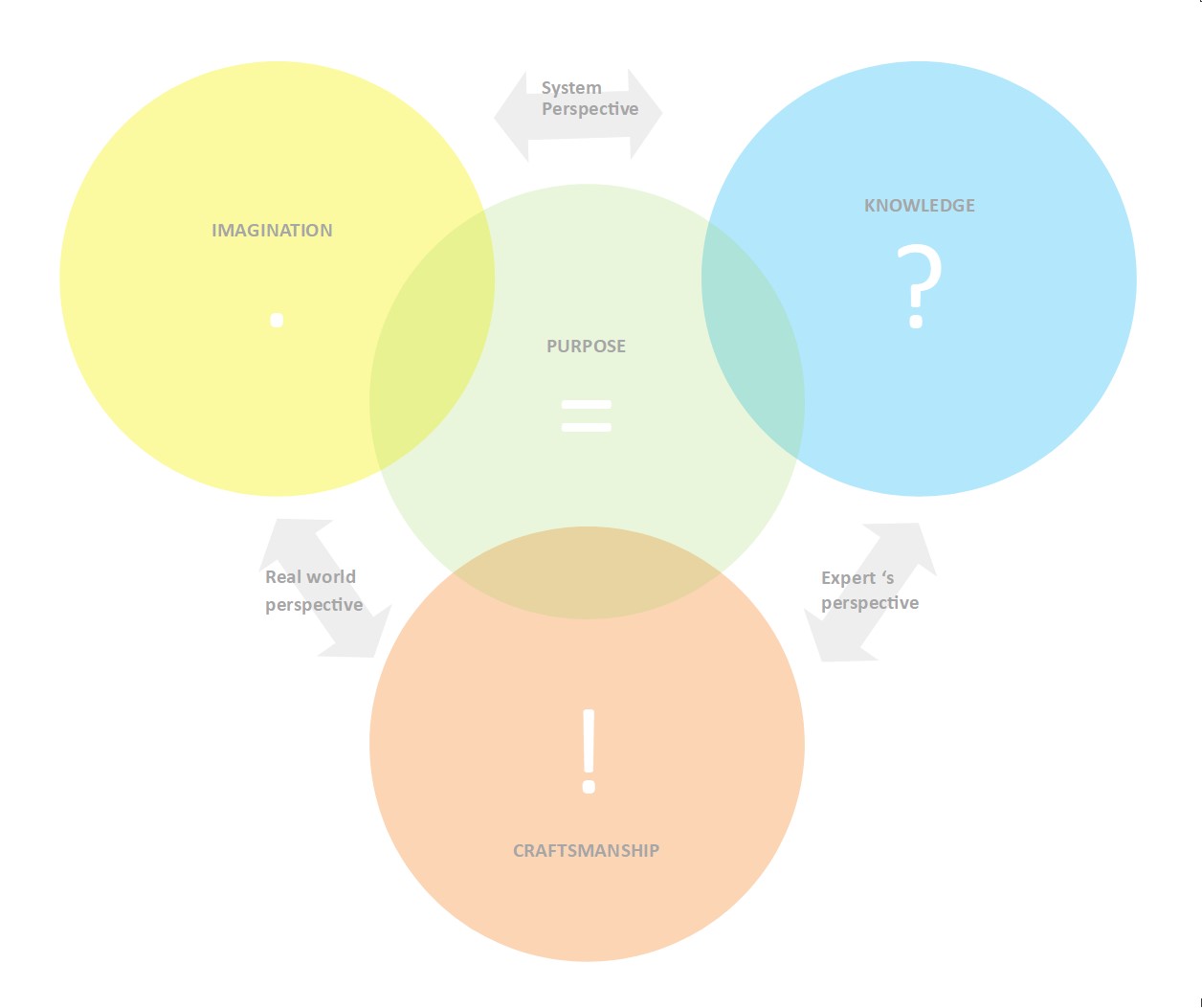
Visioning–Development–Planning is the engine that drives the development of products and systems. It is about creating new systems or evolving existing ones, starting from visioning and craftsmanship rather than relying solely on knowledge. It connects people with their work and fosters a culture of trust and collaboration within a learning environment. The approach aims to fascinate people, spark curiosity and invite them to actively participate.
Using a single visual anchor, professionals can organize themselves, and each other, in a flexible way. It guide teams to move quickly through all aspects of design and maintain flow. Participants can anticipate and see how their contribution supports the success of the project.
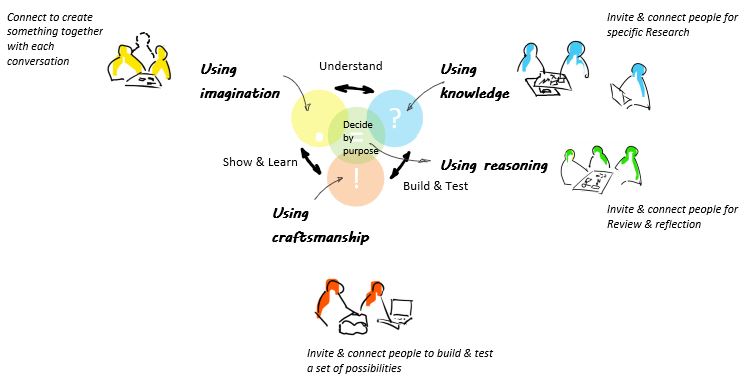
How to run and keep rolling through all aspects of the design and how participants can contribute:
The method makes complex situations understandable and tangible by visualizing situations from a systems perspective and by building models with associated properties. The structure of the design stages allows conversations to remain open and exploratory, while still leading to shared conclusions captured in only-necessary documentation. No matter where you start, every act of thinking and doing finds its place, from the first idea to production.
Visioning:
“Logic will get you from A to B. Imagination will take you everywhere”. Albert Einstein
"Using imagination"
It is:
A moment to use imagination without relying on knowledge or technology — free from judgment. It is about making your point.
What you do:
You shape your thoughts by placing elements and their interrelationships in context.
What you make:
You create a fast, sketch-like drawing that represents the situation and its context. Pen and paper — or a simple screen — work best to draw and bring others into the conversation.
Why:
To capture individual and shared thinking without limiting creativity through the use of technology.
Examples
Sketch-like representations of:
a concept of your vision or opinion
a conversation or communication
an observation
Tips for vision sessions
You can organize vision sessions where people make situations visible and tangible from their imagination, each contributing their own perspective. The visual representations are then combined, allowing similarities and differences to emerge, which form a common vision — captured in an explanatory sketch or prototype.
Closing your eyes while imagining situations and listening to conversations can help you draw the context. I learned this from a blind friend, and have been practicing it ever since. It sharpens attention and creates a focused, pleasant calm.
Note:
Translating vision into strategy can be challenging. This is where a systems approach is essential, providing a framework that makes further development possible.
"Understanding"
It is:
A moment of framing from a systems perspective, understanding the situation as it is and as it could be.
What you do:
Give meaning to the situation picture. Understand it as a system that everyone can grasp and clarify what the higher purpose is. Ask the key questions: what, who, where, when, why, how, and how much.
What you make:
The enriched situation sketch, with labels for what you know and what you don’t (knowns and unknowns).
Why:
To have a clear picture of the situation to share, connect with people, and build upon. People who can see where their ideas fit in a system are better prepared to collaborate.
Note:
The expected quality is not always obvious and will emerge through further research. Unknown unknowns may surface during this process.
Development:
"Using knowledge"
It is:
A moment to use knowledge and explore unknowns.
What you do:
Explore the system picture of the situation from different knowledge perspectives to discover needs. Place the system within a larger system, the whole and its environment. Explore how things could look, what they can do, and which processes are at play.
What you make:
A set of system model sets in which the larger system is broken down into levels, viewed through multiple knowledge lenses and labeled with knowns and unknowns.
Why:
To stimulate curiosity and research. To bring in expertise, professionalism and experience — and to learn.
Even when you already know possible solutions, take the opportunity for a short conversation with your knowledge network or peers. A quick glance from an outsider often provides inspiration and sharpens your thinking.
Note:
To provide solutions to real needs, you connect expertise, experience and knowledge. The system model sets form the foundation to build upon.
"Build and Test"
It is:
A moment to use technology and expertise, to make things work by materializing, crafting and testing.
What you do:
Develop and test the desired situation. Design multiple solution proposals for system parts and sub-aspects, and explore whether these solutions are likely to work.
What you make:
Drawings or sketches that propose solutions, including the data needed to create a set of samples or prototypes.
Why:
To prepare for creating tangible evidence. People are fascinated when they see what they have built and discover its purpose.
Note:
The quality of proposed solutions is not always easy to prove and will emerge through testing and research. Unknown unknowns may surface during testing and validation
"Using craftsmanship"
It is:
A moment to apply craftsmanship.
What you do:
Create and test the developed solutions. Build a working model (or model set) with the defined properties, and measure both the properties and their quality.
What you make:
Working artifacts, from fast, low-cost prototypes and samples to a final model ready for use. This can also include acting in (virtual) reality.
Why:
To reward curiosity and to learn through playing and testing. People are driven to make something they can show.
Note:
Everyone should be able to show their contribution, as long as it is clear what is shown, and what is not.
"Show and Test"
It is:
Using events to show and test solutions.
What you do:
Present and validate the working model with its associated properties. Validate what has been created from the perspective of users and customers, preferably in the real environment.
What you make:
A setting that allows people to experience how the model functions in the closest possible reality.
Why:
To confront users and customers with the current state of the design and research, in order to discover needs and serious shortcomings. And, equally important, to allow contributors to show the quality and beauty of what they have made.
How the core team works:
The core team leads the validation events. When enthusiasm arises, they deliberately shift the focus back to curiosity, feeding insights into the initial representation of the situation, its context and associated conditions. From there, they reflect on possible changes and their impact, using imagination.
Note:
It does not matter which phase you start with. Every act of thinking and doing falls back into the right context — from the inception of an idea to production — as long as there is a clear reason and the preparation is planned.
Planning:
"Using reasoning"
It is:
A moment of reasoning — clarifying the why and the motivation to take action.
What you do:
Review and reflect on whatever emerges. As a team, you ask essential questions:
Why are we doing this — to make or achieve what?
What can we do with what we have now?
What you make:
A shared understanding of where you are and what you really (don’t) know, combined with clear decisions about purpose. These decisions determine which fragment of the creation cycle is activated next, guiding the best possible actions.
Why:
To remain aware of purpose and to build trust in collaboration. To avoid mistakes and unnecessary effort, to appreciate outcomes, to learn — and to act consciously with what you (do or do not) have.
Examples:
Short question-and-answer moments, give-and-take discussions, organized reviews, reflection sessions, planning and prioritization meetings, and the documentation and communication of information.
Note:
A (partial) solution is only considered ready when all aspects of the pattern have been completed — even if deliberately done very briefly. Gaps in the cycle caused by time pressure or external force make professionals aware of potential consequences for development quality.
Role of the core team:
The core team makes decisions and distributes the right information with an understanding of the full context. Dot voting is not a decision-making method in the creation cycle, and communication does not rely on PowerPoint presentations or email. Information is captured in only-necessary documentation to enable teams to store and retrieve knowledge quickly and accurately.
Documentation principles:
System description records what is expected (requirements) and what has been realized (properties). Together with associated system drawings (sketches, CAD, exploded views, etc.), it forms the source for all derived information flows — such as testing and review events, bills of materials, marketing and sales activities, training and instruction data.
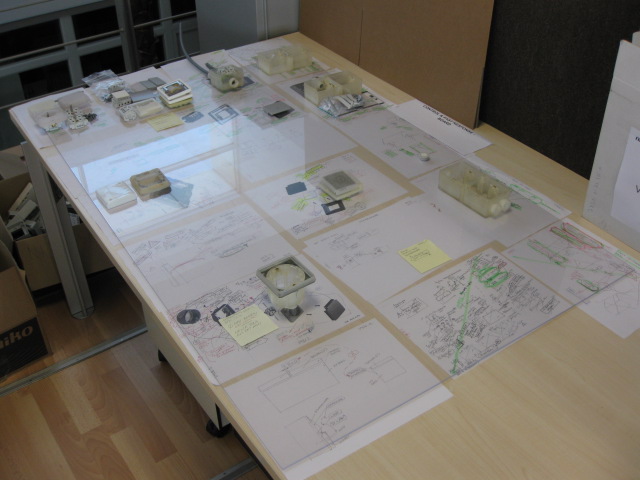
Model description records the state and origin of prototypes and samples, identified with label IDs for reference in test and review reports.
Review and decision description records what is assessed, when and how, by whom, and against which references and criteria — including comments, impact, causes, actions and a final conclusion.
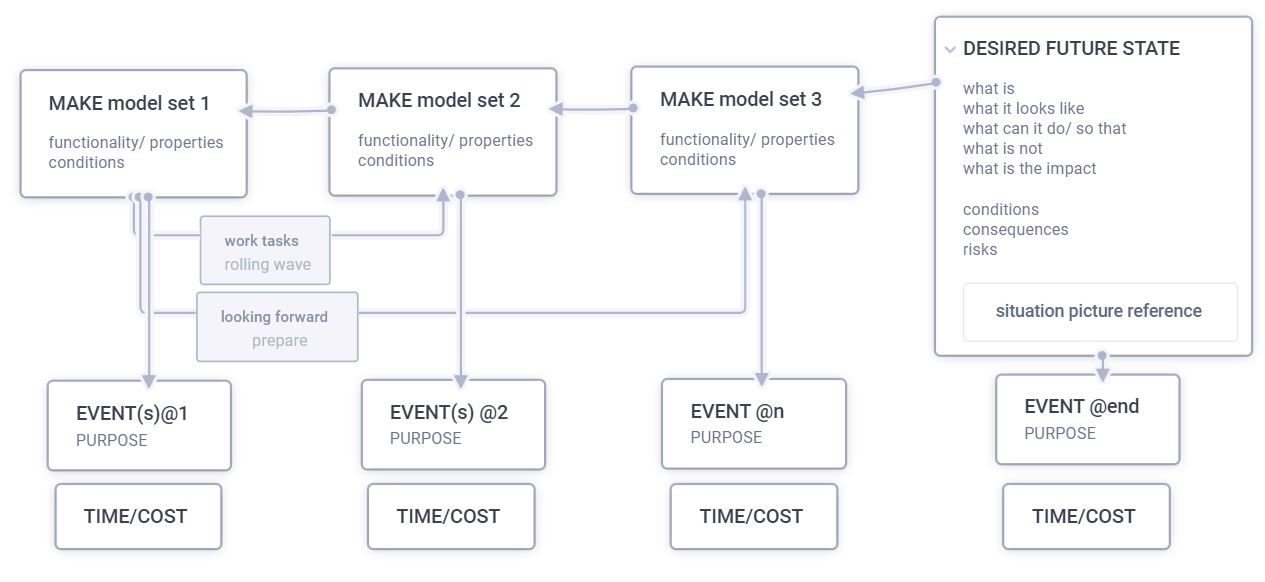
The model strategy pulls the activities to make the development.
A clear picture of the expected situation is the starting point for planning the working models that need to be created — each with an intended quality level and a delivery moment linked to events such as show & review sessions, tests, training, promotion and delivery.
Each strategic point is visualized through model specifications that describe what it is, what it looks like, what it can do and how it will be used. These strategic points pull the work that needs to be done to make them real. The focus is on making things, not on doing things.
For clarity: this is not an MS Project–style plan. It is a visual control board — a Model–Quality–Event plan — combined with a task board of your choice. At every strategic point that is reached, a model serves as a reference for what has already been made.
With the Project Table (How to set up and run a project. The Project Table set up for core team professionals) and Visioning–Development–Planning, you are in the driver’s seat to organize projects and keep collaboration running effectively in ever-changing situations. These visual anchors enable professionals to work at their best, without becoming frustrated by pressure that is imposed on the project.
Responsibility becomes visible when professionals can respond to aspects of development that are overlooked or not taken seriously.
Visioning–Development–Planning supports professionals and teams in orchestrating all elements of product and systems development simultaneously.
Do you also want to work like this? Questions about how to approach that? please contact me today.